

Reading Time: 6 mins
Key Takeaways
- Taylor Swift’s Eras Tour concerts slightly reduce assaults while modestly increasing property crime at the city level.
- Professional hockey games are associated with measurable increases in assaults, disorder, and property crime on game days.
- Concert crowds — more female, younger, and often from out of town — create a different crime risk profile than hockey audiences.
- Major events shift routine guardianship, moving crime risks across neighborhoods rather than confining them to the venue area.
- The Pinkerton Crime Index translates these shifting crime patterns into actionable insights for event planning, staffing, and risk management.
Major events bring visitors to cities and concentrate large crowds in specific neighborhoods. This sudden influx can create more potential targets and strain local guardianship. Even proactive event security planning can unintentionally displace guardianship, shifting patrols and attention away from other areas. Those shifts can lead to changes in crime patterns in parts of the city far from the event itself.
Kristina Block and Jacob Kaplan, two researchers who have contributed to the literature on sporting events and crime, explore this dynamic in a new paper, The Effect of Concerts on Crime (Taylor’s Version). Their work expands the existing research on events and crime into a comparatively underexplored area: concerts and citywide crime.
For security leaders and risk managers, these insights aren’t abstract—they impact how you staff, plan, and route people.
How the Eras Concert Impacts Cities and Venues
Block and Kaplan chose data from 288 Taylor Swift concerts in 70 cities to analyze this question of crime flows. In her most recent tour, The Eras Tour, Swift generated an average attendance rate of nearly 70,000. This is four times larger than the average professional hockey or professional basketball game, and slightly higher than average attendance at a professional football game. Swift’s Eras tour attendance numbers even surpass the in-person attendance of the 2023, 2024, and 2025 Super Bowls.
Swift concerts bring increased economic activity to host cities in lodging, food, and parking revenues. For example, after two Swift concerts in Cincinnati, Ohio, in the summer of 2023, the city reported USD 48 million in revenue that could be directly attributed to the concert.
Why Concert Crowds Create Different Crime Patterns
Concerts differ from sporting events. Sporting events change routine activity theory’s balance between guardianship, offenders, and targets, but these events are scheduled at routine intervals. Concerts are irregular and draw different crowd sizes.
Many studies exploring the relationship between sporting events and crime are limited to a single city. These studies have produced conflicting results, potentially revealing characteristics of crime and anti-crime measurements in an individual city rather than the overall relationship with crime.
Kristina Block’s 2021 study of NHL games in four major American cities found an associated increase in property crimes and assaults. In a similar study, Block and Kaplan found an increase in property and disorder crimes during NHL playoff games across 15 U.S. cities. In contrast to many of the sports studies, Swift’s concerts provide a large and heterogeneous sample for analysis. Her concerts bring together large populations in a variety of American cities over many months.
Alcohol is another key driver of crime risk at both sporting events and concerts. It impairs self-control, and research links heavy drinking to a higher likelihood of becoming either an offender or a victim. Block and Kaplan cite prior research showing that about 80% of concertgoers report drinking alcohol during the event.
Concert audiences also look different from typical sports crowds. They tend to include more women and younger fans than professional sporting events, and women are generally less likely than men to commit crimes or be victimized.
Alcohol’s crime-related effects are also stronger among men, which helps explain some of the differences seen between concerts and sports. At the same time, concerts attract more out-of-town visitors, and that unfamiliarity with the surrounding area can make some attendees more vulnerable to crime.
What the Data Shows About Crime on Eras Tour Concert Days
Block and Kaplan measured the impact of Taylor Swift concerts by comparing citywide crime counts on concert days to crime on the same weekday one week earlier. Instead of looking only at incidents near the venue, they used citywide data to capture the overall effect of the event, including crime that might shift into other neighborhoods as guardianship moves. Using precise pointlocation data would have excluded many cities, because police agencies report crime at different levels of geographic detail, so citylevel data allowed them to include the widest possible set of concert host cities in the study.
The researchers analyzed counts of simple and aggravated assault, property crimes — like theft, motor vehicle theft, burglary — and general disorder offenses. Disorder offenses encompass a broad range of crimes, including:
- Arson
- Disorderly conduct
- Public intoxication
- Graffiti
- Destruction of property
- Criminal mischief
- Riots
- Panhandling
In their analysis, they found that there is no statistically significant change in disorder crimes on Taylor Swift concert days relative to one week prior. Their analysis also found a slight (but statistically significant) decline in assaults on concert days, and property crimes did increase in a small proportion on days of Taylor Swift concerts.
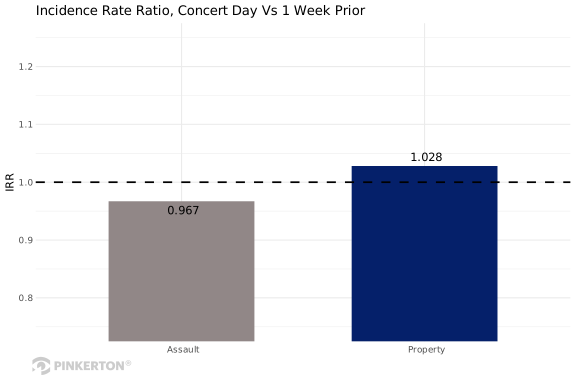
These results underscore that a city’s crime risk is always shifting. As people enter, exit, and move around, the balance between suitable targets, motivated offenders, and capable guardians changes with them. Those shifts are shaped not only by everyday routines but also by special events like concerts, sporting events, parades, and protest marches, which can temporarily reshape crime patterns across the city.
If you are planning major events, overseeing corporate security, or managing mobile workforces, the Pinkerton Crime Index can help you see how crime moves across a city at the neighborhood level—so you can time movements, allocate staff, and design event plans with greater confidence.
SOURCE
Block, K., & Kaplan, J. (2025). The Effect of Concerts on Crime (Taylor’s Version). CrimRxiv. https://doi.org/10.21428/cb6ab371.c3f515bf


